
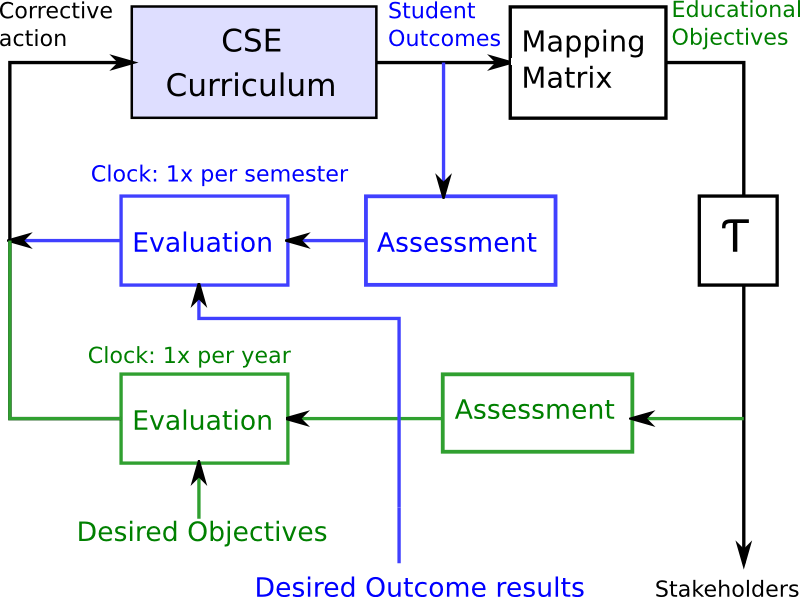
The process is the curriculum, in which each class provides the student with skills that are listed in the Student Outcomes. The Outcones are the immediate consequences of a student attending a class. It is not necessary that each class contributes towards all Outcomes at the same time, but the overall curriculum needs to contribute to all Outcomes. It is the duty of the lecturer to determine the Outcomes to which his class constributes.
Over the course of the education, the goals (termed Educational Objectives) should be met. Each of the Outcomes contributes to one or more Objectives. A mapping matrix shows to what extent one specific Outcome contributes to each Objective. The Objectives need to interpreted as broader long-term goals.
The self-improvement process requires the faculty to evaluate to what extent the goals have been met. For this purpose the extent to which the Outcomes and Objectives have been met, needs to be assessed. There are two distinct assessment processes: Assessment of the Objectives, and assessment of the Outcomes.
The extent to which the Student Outcomes have been met can be assessed on a semester-by-semester basis for each class. Quantitative assessment methods (the "sensors") need to be in place. One possible solution is the use of surveys. We could, for example, ask the students, "To what extend (grade from 1-5) do you think you have obtained the ability to apply knowledge of computing, mathematics, science, and engineering?" and average the grades for this class.
ABET distinguishes between two assessment methods: direct and indirect methods (ABET terminology). Indirect methods contain a subjective component. Surveys are therefore indirect assessment methods. Direct methods do not contain subjective elements. Some examples for direct assessment methods are
- The average score that students get in a standardized homework project
- The number of students that participate in the FE exam
- The average score that students get in the FE exam.
- The number of students that are offered a job within 6 months of graduation
Returning to the feedback model, class goals ("desired Outcomes") need to be specified by each instructor. During or after each semester, the instructor assesses the class and compares the assessed Outcome to the desired Outcome. If these are mismatched, a defined action needs to be taken. In our definition, each Outcome is graded on a scale from 1 to 5. A grade of 3 or below requires corrective action. As a group, CSE needs to continually monitor the extent to which all Outcomes are met. This means (1) making sure that the curriculum overall covers all Outcomes, and (2) making sure that the Outcome criteria are met. This is the blue part of the feedback loop.
Example: One Outcome is to provide a knowledge of contemporary issues. In a survey, students grade their perception of how much knowledge of contemporary issues they obtained from 1 (poor) to 5 (excellent). In addition, students of one class are required to present a term project based on pertinent journal articles. Their presentations are evaluated by faculty members (grade 1-5). The goal is to achieve an average grade of 4 or 5. If a grade of less than 4 is achieved, then... (define actions here).
The outer loop concerns the Educational Objectives (green parts of the feedback loop). In one example, Objective 1 ("Graduates will pursue careers as professionals in CSE-related fields as employees...") can be evaluated by the percentage of graduates that have found a position within 6 months of graduating (direct method). The goal is to reach 100%. Continually, the CSE committee discusses actions and curriculum modifications that raise this percentage whenever it falls below 80% (arbitrarily defined level of satisfactorily meeting the Objective).
The block marked τ indicates a delay. Students look for jobs, gain job experience, and are surveyed after one or 5 years.
|
EDUCATIONAL OBJECTIVES (new 2011 terminology) |
- Graduates will pursue careers as professionals in CSE-related fields as employees beyond entry level positions, as entrepreneurs, or will be making satisfactory progress in graduate programs.
- Graduates will achieve a high level of technical expertise and successfully apply system development and design processes from the component to the system level, thus establishing themselves as problem-solvers and innovators with an appreciation for real-world problems
- Graduates will demonstrate awareness of ethics and social responsibility as computer engineering professionals working in a global environment.
- Graduates will demonstrate non-technical skills such as communication, resourcefulness in working effectively across diverse groups
- Graduates recognize the need for life-long learning and continue to work to advance professionally
|
STUDENT OUTCOMES (new 2011 terminology) |
Draft. Needs to be validated against criteria in ABET documentation. Note that the wording does not exactly match ABET - find the document here.
Upon graduation, students majoring in the CSE program will have attained:
a. an ability to apply knowledge of computing, mathematics, science, and engineering.
b. an ability to design and conduct experiments, as well as to analyze and interpret data.
c. an ability to design, implement, and evaluate a computer-based system, process, component, or program to meet desired needs, within realistic constraints specific to the field.
d. an ability to function effectively on multi-disciplinary teams.
e. an ability to analyze a problem, and identify, formulate and use the appropriate computing and engineering requirements for obtaining its solution.
f. an understanding of professional, ethical, legal, security and social issues and responsibilities. an ability to communicate effectively with a range of audiences.
g. the broad education necessary to analyze the local and global impact of computing and engineering solutions on individuals, organizations, and society.
h. a recognition of the need for, and an ability to engage in continuing professional development and life-long learning.
i. a knowledge of contemporary issues.
j. an ability to use current techniques, skills, and tools necessary for computing and engineering practice.
k. an ability to apply mathematical foundations, algorithmic principles, and computer science and engineering theory in the modeling and design of computer-based systems in a way that demonstrates comprehension of the tradeoffs involved in design choices.
NOTE: CSCI has an outcome i (which we won't use) and is missing two outcomes. This is no problem as the assessment of these outcomes can be done with our engineering courses alone.
|
MAPPING TABLES |
WORK IN PROGRESS:
UGA shares with the other research universities of the University System of Georgia the following
core characteristics:
I. a statewide responsibility and commitment to excellence and academic achievements having
national and international recognition;
II. a commitment to excellence in a teaching/learning environment dedicated to serve a diverse and
well-prepared student body, to promote high levels of student achievement and to provide
appropriate academic support services;
III. a commitment to excellence in research, scholarship and creative endeavors that are focused
on
organized programs to create, maintain and apply new knowledge and theories; that promote
instructional quality and effectiveness; and that enhance institutionally relevant faculty
qualifications;
IV. a commitment to excellence in public service, economic development, and technical assistance
activities designed to address the strategic needs of the state of Georgia along with a
comprehensive offering of continuing education designed to meet the needs of Georgia's citizens in
life-long learning and professional education;
V. a wide range of academic and professional programming at the baccalaureate, master's and
doctoral levels.
The CSE Educational Objectives match the UGA core characteristics. Details can be found in
this mapping table:
ASSESSMENT METHODS
First-draft Outcome - to - Objective matrix.
(1) (2) (3) (4) (5)
Careers
Expertise
Responsibility
Non-technical skills
Life-long learning
a X
b X
c X X
d X
e X X
f X X
g X X
h X
i X X X X
j X X
k X X
(1) (2) (3) (4) (5)
Careers
Expertise
Responsibility
Non-technical skills
Life-long learning
I X X X X
II X X
III X X X
IV X X X X X
V X